Monday, November 23, 2009

Just Hang On, Baby


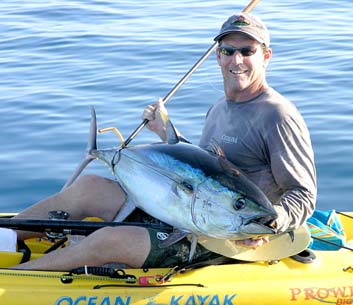
Click on this link for a fascinating story about a Chicago options trader whose hobby is fishing for large, fast, ferocious tuna -- from his kayak.

Money quote:

"It never occurred to the authorities that someone might be crazy enough to want to catch a bluefin while sitting in what amounts to a floating plastic chair and enjoying what Melville called a “Nantucket sleigh ride.”"

Thursday, November 12, 2009

Callous? Stupid? You decide.


A couple of days ago a bill landed on the desk of Rhode Island governor Don Carcieri which would add "domestic partners" to the list of people who are allowed to make funeral arrangements for a person. Carcieri vetoed the bill. His reason? According to CBS News it was that the legislation represents a "disturbing trend" of the incremental erosion of heterosexual marriage.

If you've read any accounts or heard stories of gay partners in long-term relationships being denied the right to even attend their partner's funeral, let alone make the arrangements for the service, you know how painful and humiliating it can be. You can read a few in the comments section on the post regarding this story at Joe Jervis's blog. Here is just one: "Shortly after my partner was killed in a traffic accident, his mother had his remains moved to another location and refused to tell me where they took him. They actually dug him up and when I went to the cemetery, I found an empty grave. She said that she didn't want me "desecrating" his grave by putting flowers on it. Earlier, I was allowed to attend the funeral, but was told that the burial was for "family only." We had lived together for six years."

There are many stories like this. And it seems callous of Carcieri to deny committed couples the right to make funeral arrangements for each other. Given that the bill was passed out of the legislature with a veto proof 64-1 margin, it also seems sort of politically brain-dead.

However, Carcieri did make one point that I sort of agree with. The bill established criteria for what constitutes a "domestic partnership" and Carcieri believes those criteria are sort of vague. They include living together at least a year and being "financially interdependent," such as owning a home together or sharing a credit card. Carcieri believes a "one year time period is not a sufficient duration to establish a serious bond between two individuals...[relative to] sensitive personal traditions and issues regarding funeral arrangements."

Here's where I agree (and where this starts to sound like "The View"). Say your daughter has shacked up with a guy and he talked her into adding his name to her credit card. If your daughter died and the live-in BF wanted to have her body cremated in defiance of your wishes and religious tradition, I have a hard time seeing why his wishes should take precedence over those of her family.

Clearly it's not that I don't want people in committed relationships to be able to make funeral arrangements for each other (or inherit without taxation, visit each other in the hospital, etc.), it's just that when it comes to important issues such as these, that's what marriage is for. If you want those rights, you need to take on the responsibilities, as well. It's just another reason why we need marriage equality.

Sunday, November 08, 2009

Thought Experiment


Here's the question for today. Let's say someone has told you that tomorrow morning you will dropped at a randomly chosen place on one of Earth's land masses and you have to make your way back home. You get to wear whatever you choose in terms of clothing, but you only get to take one other man-made thing with you. What would you choose? A knife or other weapon, perhaps? A satellite phone? A Visa card? Other than those three, I can't think of anything else that would be a reasonable choice.

The chances are good you are going to end up in a very inhospitable environment. About a third of the land masses are either mountain ranges, deserts or capped with ice. Even if you hit the two-thirds that is mostly habitable, odds are you aren't going to be anywhere near a city or town of any size. So what item would be most useful to you?

The satellite phone is a fine option because you can immediately call for help. But if you don't know where you are, how can you tell people how to find you? (Though I suppose the authorities could probably track the phone signal to you, if you could convince the authorities it wasn't a prank before the battery ran out.)

A weapon is also useful, especially if you end up dropped in an inhospitable environment where you might face wild animals or even human threats. I suppose you could also use the weapon to obtain money or goods through the threat of force, but you would also likely run into people with bigger and more weapons who might thwart this plan of action.

I think a strong case can be made that a Visa card could be the winner. It may be of little use in a jungle or in a desert, but once you got yourself to almost any sort of settlement, it would be a widely-recognized symbol that you would be able to pay for the assistance you are requesting and would be greeted with more warmth (and likely equal respect) than you would brandishing a weapon.

Anyone else have any ideas?

Tuesday, November 03, 2009

Gettin' Jiggy with Aaron Burr


Lin-Manuel Miranda, creator of "In The Heights," 2008 Tony winner for Best Musical, performing at the first White House poetry jam. Beautiful.

Wednesday, October 28, 2009

Legalize it, tax it, regulate it

Here is an article from today's New York Times.

One quote jumped out at me: "In a memorandum on Oct. 19 outlining the medical marijuana guidelines, Deputy Attorney General David W. Ogden said marijuana was “a dangerous drug, and the illegal distribution and sale of marijuana is a serious crime,” adding that “no state can authorize violations of federal law.”"

Dangerous? By what criteria? It's impossible to overdose on, there's no risk of physical addiction, the risks that come from smoking it are minimal and even those can be mitigated by ingesting it or vaporizing it. By every measure it is much safer than alcohol and far safer than tobacco.

Think of the resources we waste pursuing, arresting and incarcerating those involved in the growing, selling and use of marijuana. Then think of the revenue boost we would get from taxing it.

Please, please, please can't we approach public policy issues with common sense and rationality and not baseless fear-mongering?

Saturday, October 17, 2009

Nagging Thoughts

Recently, the Research Digest Blog asked a group of respected psychologists and neurological researchers to describe one thing about themselves that - despite all their knowledge and training - they still don't understand. Some answers (they had to be 150 words or less) are fascinating, some just egoistical. But they are all interesting in their own way.

Here's what Stephen Rose had to say: "A lifetime studying the neurobiology of learning and memory, and I still wonder about St Augustine’s questions 1600 years ago: "How does my brain/mind encompass vast regions of space and time, abstract thoughts and numbers, false propositions" - or for that matter the memory of my fourth birthday party or what I had for breakfast yesterday. Meantime, I am embarrassed by the naivete of my fellow neuroscientists who mechanically collapse mind into brain, or claim to be able to localise within that mass of tissue: equity, empathy, romantic love... "You’re nothing but a bunch of neurons" claimed Francis Crick, locating consciousness in the anterior cingulate gyrus. Lombroso redux indeed! As the mind is wider than the brain, to misquote Emily Dickinson, what other sciences/knowledges do we need to bring to bear to understand ourselves?"

Thursday, September 17, 2009

To Hell with Bipartisanship


As ABC News said today: "If Sen. Max Baucus' bill -- with its smaller price tag, no employer mandate, and no public option -- doesn't draw at least a few Republicans, what will?"

For the past several months, the President and Democrats have been reaching out across the aisle, looking for some thread of bipartisanship as we struggle with how to fix a healthcare system that is so broken that nearly 2/3 of all personal bankruptcies are due to medical expenses -- and 80% of those bankruptcies are from people who actually had health insurance.

As much as I've hoped Congress would work to find common ground through common sense solutions, that's apparently not going to happen. (I guess I don't have the influence I ought to.) That's why it's time to end the bickering -- in a partisan way. The American people elected a Democratic president and put strong Democrat majorities into both houses of Congress. I can't speak for the other 127 million voters, but I cast my vote in the hope of getting something done, and putting this country back on a progressive track after eight years regressive, macho posturing and pandering to base instincts.

So I say to hell with bipartisanship. Screw the Republicans. They had their chance. Americans voted for Obama and the Democrats because we wanted change. If we'd wanted to remain beholden to special interests and old ideas we would have voted for John McCain and the Republicans. We didn't. So if the Republicans refuse to come along, leave 'em behind. Vote for a solution that works for America, not one that works for the Republican minority.

Saturday, September 12, 2009

"American Idiot" at Berkeley Rep


I can’t really say I ever went through a “punk” phase. In 1978, during my junior year of college, when the Sex Pistols were on their first U.S. tour, my roommate and I ripped up a couple of t-shirts, wrote slightly rough, provocative words on them (“bite” is the only one I remember today), spiked our hair and manipulated safety pins to look like they were piercing our cheeks. Then we walked around campus for an afternoon and enjoyed the stares – this was BYU, after all!

Though the punk sensibility never really fit me (I’m just not that nihilistic), I – like most teenagers – identified with the sense of angst and rage at a larger world of which you’re not yet truly a full participant. I liked the Sex Pistols (in small doses), loved The Clash (still do), but found my own way of dealing with the anger and anxiety of youth.

It is that sense of angst and aimlessness and limited options that provides the backbone for the new musical version of Green Day’s mega-platinum, Grammy-winning punk rock opera “American Idiot” that is currently in previews at Berkeley Rep’s Roda Theater.

“Opera” may be a misnomer in this case. The show is more of a punk rock tone poem in that there is really very little story going on here, but rather an evocation of teen disaffection and confusion in the context of a world saturated with millions of conflicting political and media messages.

“American Idiot” centers around Jesus of Suburbia, a young man who hangs out in the 7-11 parking lot with his friends before he and his two best buds Will and Tunny go their separate ways: Jesus heads to the big city, Will ends up an Army grunt in Iraq and Tunny stays home with his knocked-up girlfriend. (Or maybe it’s Tunny who goes to Iraq, I wasn’t really sure which one was which.)

All three of these young men spend far too much time in basements and on worn-out, Levitz-level furniture, parked in front of TV sets, taking in the endless stream of media – that is represented for us on a towering set covered with propaganda from multiple generations and pockmarked with 20 or so flatscreens that display a variety of video and animations throughout the show.

Somewhere inside them, these three boys must have dreams – but we never get to learn what they are. In “Rent” and “Spring Awakening” – the two shows most closely related to “American Idiot”, the longings of disaffected youth are spoken. They want to create art, or get laid, or break free from their parents. Here the main characters’ dreams – if indeed they have any – are kept from us. We know those dreams are there because we can see the disappointment and anger they feel at not achieving them, and in the realization that they have no discernible means of achieving them.

If any dream at all is voiced, it’s in the very first line of the show: “Don’t wanna be an American idiot!” That’s the extent of their aspiration – to not be a mindless drone in a world run by giant corporations and heartless, terror-producing governments. Jesus, Will and Tunny don’t know what they want to be, they just know what they don't want to be.

If this all sounds a bit dark and depressing, it is. Sort of. It’s rather hard not to be when one of the key themes of a show is “Nobody likes you. Everyone left you. They’re all out without you, having fun.” But “American Idiot” is also a brilliant, explosive, heartfelt work of art that – if you can handle volume – you really ought to see. The music is amazing and the onstage band rocks every corner of the house. The story’s a bit thin, but the show’s not about story – it’s about emotion.

I have only two quibbles with the show. First is with the set design. The screen placements aren’t quite haphazard, but they’re not linear, either, and the hanging car seems out of place. The whole thing is a bit derivative of U2’s amazing ZooTV tour, yet it lacks the chaotic energy that made that environment so compelling.

Second quibble is the cast. Mostly excellent, but if this production ends up on Broadway – as I expect it will – they might want to consider recasting some of the ensemble and perhaps even John Gallagher, Jr. as Jesus of Suburbia. I loved him in “Spring Awakening,” but for some reason he didn’t always connect with me in this role. One part that should not be recast is Tony Vincent as St. Jimmy. From the moment he appears on stage, he commands your attention. When this gets to Broadway, look for a Tony nod for him.

Quibbles aside, if you’re anything like the audience last night at Berkeley Rep, you’ll love “American Idiot.” The standing ovation was almost immediate. And with good reason. For a production that is still in early previews, “American Idiot” is polished, shining with a grungy glamour and working hard to shake everyone out their anxiety-ridden stupors, whether the cause is teenage angst or the middle-age realization that maybe all your dreams aren't going to come true. But that’s OK. After all, happiness lies not in getting what you want, but wanting what you have. And what you have in “American Idiot” is the most interesting American musical to come along since, well, “Spring Awakening.”
Tuesday, September 08, 2009

Saturday, September 05, 2009

It's All Bullshit

Wine competitions, that is.

Back at Work -- for Today


Since I began this blog I've had periods where I wrote several posts a day -- as well as periods where I went as long as a week without writing.

However, it's now been more than two weeks since I last posted. I don't know if any of my nine regular readers are still out there, but I figured you deserved an explanation for my absence.

Facebook must be part of it. I now have another outlet for interesting links and (brief) half-baked ideas. Facebook is easy and fun and several dozen of my friends and family are part of my Facebook community.

Priorities factor into the situation, as well. I've had a big proposal I was working on, plus another smaller project; they received most of my attention.

But as I reflect on it, I think the biggest reason I haven't been posting is also the biggest reason I should be posting: the increasing political polarity that is happening in America.

In one of my earliest posts I said: "I can’t help believing that most Americans don’t feel represented by politicians who become more and more entrenched in their partisanship with each passing day. I simply refuse to believe that most Americans aren’t disgusted by the posturing and vitriol and name-calling being passed off by talk radio and cable news pundits as the "national debate.""

Unfortunately, in the 3-1/2 years since I wrote that, nothing has changed. We have a new president, but no truly new agenda. As was ever the case in politics, promises seem to be there to be broken. Congress continues to focus on differences, with the right wing pulling even harder to the right and the left allowing themselves to be pulled. There's movement, but the two sides never seem to get closer to each other. Or to us.

Bottom line, the political scene is depressing as hell. And I don't know what my little, lightly-read blog can do to help (and I still don't like to post unless I have something at least semi-interesting to say), so I keep quiet. For now.

NOTE: the photo is of the trail from the fourth green to the fifth tee at my favorite local golf course, and is the first photo I took with my new digital camera.

Thursday, August 13, 2009

Choose Your Battles


Drug abuse is an awful thing. I can't imagine there is an American family that hasn't been wounded by an addiction of one or more of its members to one or more substances. Kind aunts racked with cigarette-caused lung cancer. Adorable nephews seized by the death grip of methamphetamine. Fathers neglecting their families while lost in alcohol-induced stupors. Fortunes blown on cocaine, futures surrendered to heroin.

Nicotine and alcohol are and will remain legal, regardless of the dangers they pose. Given the addictive nature and inherent dangers of heroin and cocaine, it's hard to imagine any sort of push to legalize their production and distribution.

But marijuana? By all scientific measures, it's far safer than either cigarettes or alcohol. One can become emotionally dependent on pot, but there is absolutely zero risk of physical dependence. There are no withdrawal symptoms even if a daily user one day simply stopped.

But the people who like it, like it. And there are millions of them, all across the country. They like getting a little buzz on after work or before going to a movie or having a delicious meal or making love. Some use it to treat nausea or insomnia or arthritis -- and it works for them. So there is demand for it. Lots and lots of demand.

This comes to mind in thinking about Barack Obama's recent statement during his visit to Mexico, when he said, "the United States will also meet its responsibilities by continuing our efforts to reduce the demand for drugs..." Sorry. Not gonna happen. You can't reduce demand. People like the way marijuana makes them feel. Just like the way other people like the way a couple of shots of Jameson or a long drag off a Camel Light makes them feel. I mean, it's nice to imagine you could convince some people they'd be better off not smoking or drinking or toking, but demand comes from a place deep inside people that government simply can't get to.

So if you can't reduce demand for a substance, even when that substance can have negative effects (especially when used habitually or to excess), what do you do? We tried banning alcohol, interdicting it, making criminals out of people who were just after a bit of relaxation or reduced inhibition -- not to mention allowing real criminals to get easy access to some real money by supplying the in-demand contraband to willing buyers.

You can educate people on the dangers of use and abuse. Cigarettes hold no interest to me, partly because of the cancer risk, but partly because the four times I've used tobacco, the nicotine high never did anything for me. Other than make me dizzy. I wouldn't go near crystal meth. Or heroin. I ingest caffeine only occasionally, partly because it makes it hard to fall asleep if I have it after about 11:00 a.m. and partly because I don't like having to have a cup of coffee to get started in the morning. I don't like that sense of being dependent.

But not everyone is as easily educated as I. So let's agree then that meth, heroin and cocaine are the big three bad boys of the drug world, the substances we think are so dangerous we can't let anyone use them. Problem is, the demand hasn't gone away. People who need heroin or meth or coke really need them.

Problem is, the people who like their pot (and get it from Mexican sources who also trade in the harder stuff) are partially funding the efforts of drug traffickers to evade the law. The millions that come in from mostly harmless pot can be used to buy planes to smuggle heroin and guns to protect the shipments (or kill off rival drug lords).

So why not legalize marijuana and pull the money rug out from under them? That's the thesis of a thoughtful letter from one of Andrew Sullivan's readers. Money quote:

"Mexican organized crime would be devastated if we could run marijuana through legal channels. They make most of their money from pot. Not only that, but they use their vast distribution networks for marijuana to move their other drugs. More marijuana is consumed in this country than all other illegal drugs combined. The black market for illegal drugs is mostly a black market for marijuana. All the drugs can be found in this black market though, with most of them coming from the same organizations up the line. When we legalize marijuana we're going to take millions of participants out of the black market for illegal drugs. This will make it harder for these Mexican DTOs to get their cocaine, meth and heroin and whatever else they are selling out to the public. If we have "pot stores" like liquor stores, these pot stores will be no more likely to sell all these other illegal drugs than liquor stores. The black market for illegal drugs and organizations like these Mexican drug trafficking organizations will shrink down to something much smaller and easier to contain."

If we're going to continue to have a war on drugs, let's at least fight the right enemy.

Look Out Below!

There are thousands of large objects -- asteroids, mostly -- that could one day collide with Earth with enough impact to render our dear blue sphere inhabitable to a demanding species such as ours. Fortunately, space is large and can contain thousands of objects quite safely for quite a long time. About 500,000 years or so. On average, that's about the amount of time between catastrophic impacts, like the one that may have turned the dinosaurs into the extinction cliche they have become.

NASA, however, has been trying to keep an eye on them for us. For the past years, they have been watching for and cataloging as many of the larger objects as they could. In fact, they are closing in on identifying at least 90% of all objects in near-Earth orbits that are larger than a kilometer across. If one of those hits the Earth -- anywhere -- humanity's lights will be turned out permanently. The agency was planning to catalog 90% of smaller objects, too, those that are a minimum of 140 meters across. Though much smaller, they could still leave a nasty mark.

Unfortunately, budget cuts have meant this goal will likely not be met. Which means one morning we could wake up to find a giant rock hurtling toward us.

I'm all for watching out, but if we see one coming, can we really do anything about it? NASA has a plan to try and deflect such an object, if it can be detected early enough, but do we really have the capability to turn a giant asteroid from its course? You can find a link to NASA's deflection plan here.

Here's the Cliff Notes: "Unless there are decades of warning time, hazardous NEOs (those are Near-Earth Objects) larger than a few hundred meters in diameter may require large energies to deflect or fragment. In these cases, nuclear explosions, either stand-off or surface blasts, might provide a suitable response. For the far more numerous objects that are smaller than a few hundred meters in diameter, and provided there is a sufficient warning time, a kinetic energy (KE) impactor spacecraft might be sufficient to deflect the hazardous NEO so that it would miss the Earth at the time of a predicted impact."

Key word in both those instances: might.

So wear a hat.

Saturday, August 08, 2009

These are Real People We're Talking About

Whenever people get caught up in the abstract rejection of marriage equality -- almost always with religious "justification" (if the haters can put "marriage" in quotes when referring to my relationship...) -- I think it's important to remind them that the denial of equal civil rights has real consequences on actual human beings. Jonathan Rauch of the National Journal brought that home once again with a great piece yesterday, in which he details the struggles of his gay brother and the brother's partner of 30 years when one of them was hospitalized with a serious infection.

Money quote:

"Having just been told, at 3 a.m., that his partner of three decades might die within hours, Mike Brittenback was told something else: Before rushing to Bill's side, he needed to collect and bring with him documents proving his medical power of attorney. This indignity, unheard-of in the world of heterosexual marriage, is a commonplace of American gay life.

Frantic, Mike tore through the house but could not find the papers. He would need to retrieve them from a safe-deposit box. Which was at a bank. Which did not open until 9 a.m."

Wednesday, July 29, 2009

Target of Terror

While there have been plenty (far too many, in fact) instances of gay-bashing in this world, this is the first incident which I've heard of that feels like what we normally think of as "terrorism."

At the Outgames, currently taking place in Copenhagen, two bombs were thrown onto the running track at the stadium, injuring one runner. Earlier, three men were beaten on the streets of Copenhagen after the opening ceremonies. The hate, the hate, the hate -- what does it accomplish?

An Affirmation of Life


Reflections on the momentous achievement (despite the ultimate defeat) of Tom Watson in this year's Open Championship by Tom Friedman. Money quote:

"Watson has unique golfing skills, but if you are a baby boomer you could not help but look at him and say something you would never say about Tiger or Kobe: “He’s my age; he’s my build; he’s my height; and he even had his hip replaced like me. If he can do that, maybe I can do something like that, too.”

Tuesday, July 28, 2009

Answer the question, congressman (woman)!


It's a simple question, yet they avoid it. Hard not to get fed up with politicians, isn't it?

Saturday, July 25, 2009

Africa Unite!


With the rest of the world.

The completion of a new submarine fiber optic cable will give Kenya and several other East African countries faster, more widespread, less expensive access to the Internet. Which means some huge opportunities for people in those countries to more effectively participate in the global economy. Which seems like a good thing. One of these days, when you call United Airlines, instead of getting someone in Bangalore, you might end up talking to Mombasa.

Thursday, July 09, 2009

Handicapable


Labels get a bad rap. Yes, in some instances they can be abused when people allow stereotypes to affect their judgment of individuals based on attributes shared by a broader group. But when they are accurate (and used judiciously), they can communicate a lot of information very efficiently.

This thought comes to me as I apply for an online golf handicap and am asked to choose what sort of golfer I am from the following list:

Beginner
Hacker
High Handicapper
Bogey Golf
Mid-80s
Low Handicapper
Scratch
Teaching Pro
Touring Pro

Those are labels that work. Each is just about the right amount of information to determine how good a golfer someone is, and therefore how comfortable you might feel playing a round with them.

I'd quibble about the Teaching Pro and Touring Pro categories. I understand why the service would want that information, but it spoils the climb from least-skilled to most-skilled. At least the inclusion of Teaching Pro does, since I've known several teaching pros who are no longer scratch golfers. Give the pros a different box to click.

Now it was time to label myself. I was tempted at first to select "Mid-80s" for my skill level, but only for a moment until checking "Bogey Golf." I may have had a few rounds in the mid-80s, but I'm a much more reliable 88 or 92 still.

Then it got worse. They wanted to know my personality. But for this far more complex labeling task I was offered only four options:

Competitive
Passive
Playful
Focused

Which is why the choice was much tougher. I'm definitely competitive. (Oy, am I compeititive.) Certainly not passive. Playful? Yes, but I don't want people to think I'm frivolous. Focused? On golf, yes. In general? Well, I'm not called "ADD boy" by one who knows me well for nothing. Competitive it was, though I worry some might read "competitive" as "jerk who yells at himself, throws clubs and plays head games with you".

As labels, that meager collection doesn't tell you much. How much harder is it to choose 30 or so traits and let people choose three to describe themselves?