Sunday, April 26, 2009

New York, Spring 2009 -- Day 11 "Blithe Spirit" "Why Torture is Wrong and the People Who Love Them"


"Blithe Spirit"
To be honest with you, I'm a lot more excited about "Why Torture is Wrong and the People Who Love Them," so I'm going to cut to the chase on "Blithe Spirit": Angela Lansbury is wonderful, and it's exciting to see her doing such good work at 84. Rupert Everett is not aging well, and he's still not quite 50. Christine Ebersole is elegant and ethereal. My favorite cast member was Susan Louise O'Connor as Edith, the maid. The play itself is witty at times, but a bit clunky. Production rather lackluster overall.

Now, on to...


"Why Torture is Wrong and the People Who Love Them"
Without spoiling your evening, "Why Torture..." is not really about torture. It's about reconciliation. It's about the desire to take back your bad decisions and make things right again. But since it's written by Christopher Durang, it goes at these serious issues in a relatively absurd, outlandish, biting, and frequently brilliant fashion.

The story is simple: Felicity (Laura Benanti) awakes after a night of drinking to find herself married to Zamir (Amir Arison), a man of vague Middle Eastern descent -- but who claims he is Irish. When Zamir turns out to have an extremely volatile temper, no job and no prospects, plus a mysterious past, Felicity decides to annul the marriage. Since Zamir threatens violence at this suggestion, Felicity turns to her parents for help -- especially her arch-conservative father, Leonard (Richard Poe).

Leonard obsessively toes all the Conservative lines: hates immigrants, loves guns, thinks the gays ruined marriage, won't have the U.N. spoken of in a positive way in his home and thinks shouting "Don't you remember 9/11?" atones for any statement of xenophobia, paranoia or incitement to violence. He's like one of the suits in a Tom Tomorrow cartoon: spouting the justifications of the Limbaugh dittoheads with such unashamed fervor that it lays bare the ridiculousness of their positions.

When Dad meets Zamir, you can imagine where his mind leads him. Actually, given the whacked nature of the world Durang has created, you probably can't. Which is exactly why you should see "Why Torture is Wrong and the People Who Love Them" as soon as you can, especially since it is scheduled to close May 10. Go if for no other reason than to see the brilliant comic actress Kristine Nielsen as Felicity's mother, Luella, who has built a wall of denial that would put the Chinese to shame. Go to see John Pankow's Reverend Mike (he married Felicity and Zamir), a Christian who actually champions the true principles of Christ (love, forgiveness, kindness, gentleness), while at the same time being a pornographer. ("God created sex. He watches it, why shouldn't we?") Go for the amazing turntable set that is able to create so many different settings that it is almost like a magic trick.

If I were being critical, I'd say the play is a bit loose in its timing, and starts a little slowly -- but I was laughing too hard and thinking too much to really be critical. This is satire that cuts so cleanly that it takes a while to realize you're up to your ankles in blood.

Saturday, April 25, 2009

New York, Spring 2009 -- Day Ten "Offices" "Sleepwalk With Me" "9 to 5"


"Offices"
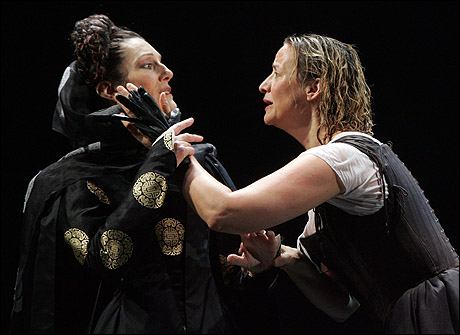
Move along, nothing to see here. An interesting, talented cast, with taut direction from Neil Pepe, on a great set by Riccardo Hernandez... performing what feels like a set of sketches or notes for a larger work. I love the Coen Brothers (Ethan [that's him in the picture] wrote this collection of three short plays that all take place in bland offices), but despite some good lines and some funny physical business, this isn't a play, it's a workshop.


"Sleepwalk With Me"
Since Mike Birbiglia, the writer and performer of this monologue/stand-up act confesses in the show that he subscribes to a Google alert that lets him know when he's mentioned in a blog, I'm going to assume he's reading this, so I'll address the rest of this post to him:

"Mike:

At one time I had some sleep disturbance issues, and before I saw the show I had this fantasy of hanging out afterward to meet you and share what-I-did-while-I-thought-I-was-asleep stories. But dude, I got nothin' on you. Sure, our stories have some similar aspects -- raised Catholic, ADD, insomnia, spending time in a relationship that we weren't being totally honest about, working as stand-ups...there may be a few more. But there were important differences, too. First, you took the sleepwalking shit to a whole new level. Second, you're actually a good standup -- I sucked. Not so much I didn't get paid, but enough that choosing a different career was a wise choice. So I didn't stay after. (But if you want to hear my semi-hilarious stories about sleep issues that I once considered doing a monologue on, send me a mail. We'll talk. I also want to hear your theory on bisexuality to which you referred but never expanded on.)

In the meantime, rest assured that I think your show is terrific. Funny, insightful, great timing, brilliant call-backs. I even became a Facebook fan. And if I took the effort to do that, well...

Anyway, I'll tell my New York friends -- and all eight readers of this blog -- that "Sleepwalk With Me" represents the best laugh-per-dollar ratio of any show we've seen in New York this trip."

Now, so I'm not lying to Mike: "Sleepwalk With Me" represents the best laugh-per-dollar ratio of any show we've seen in New York this trip. Go see it.

"9 to 5"
If you have fond memories of the 1980 film and are looking for a mostly faithful staged recreation of the film, you'll love the new show opening this week at the Marquis Theater. On the other hand, if you're hoping for a reinvention of the Dolly Parton-Lily Tomlin-Jane Fonda reeler, look elsewhere, as there is very little that is fresh about this effort. Oh, a few new lines have been added and the Lily Tomlin character gets a love interest (which I don't believe happened in the movie -- it was so long ago), but that's about it.

Not that that's so awful. "9 to 5" is a highly-entertaining -- if ridiculously implausible -- story, filled with outsize characters and farcical action. In fact, it's the elements of farce that give "9 to 5" the musical its biggest boost. The physical action -- especially the kidnapping of villain CEO Franklin Hart -- is perfect for the stage. All this -- the solid foundation of a good story and lovable (and hateable) characters -- combined with top-notch work in staging and lighting, plus a first-rate troupe of choristers make "9 to 5" a crowd-pleaser.

Unfortunately, for this member of the crowd, the production never really found its feet. Allison Janney (in the Lily Tomlin role), much as I love her acting, doesn't seem comfortable in the part yet. Her voice, while pleasing and in pitch, simply isn't powerful enough for a Broadway house. There's no Susan Boyle moment here. The other key roles are strong, but the cast doesn't feel like a true ensemble yet.

That said, the audience loved the show (and I loved being able to say "hello" to John Cleese, one of my heroes, who was sitting behind me), and it should have a decent run, especially with female audiences, who will no doubt appreciate the "womyn-power" theme. I'm guessing the mostly male crowd of critics will be a tad less kind.

New York, Spring 2009 -- Day Nine "33 Variations"


The big news about "33 Variations," the new Moises Kaufman play at the Eugene O'Neill Theatre, was the return to the Broadway stage (after a three decade absence) of Jane Fonda. Broadway seems to love it when big Hollywood stars return to the boards. They bring in new audiences and call attention to the world of legitimate theater, which mostly flies under the entertainment world radar.

Unfortunately, critics are rarely kind to the stars of the silver screen when they are there for the viewing night after night, in ordinary life-size proportion. Perhaps it's a case of familiarity breeding contempt. Once stars are there before our eyes in flesh and blood form, instead of gigantic representations in dancing light, perhaps something is lost in the minds of critics.

But this time around, Jane Fonda has bucked the trend and received mostly positive notices for her performance. Unfortunately, the play itself is coming under fire. I say unfortunate because I had a delightful evening. Not only was Jane terrific -- sincere, honest, displaying a wonderful, graceful physicality -- the play was compelling and entertaining, if occasionally a tad facile and predictable.

Fonda plays Dr. Catherine Brandt, a musicologist who has fallen ill but is obsessed with completing a final monograph before she dies. The subject of the paper is Beethoven's "33 Variations on a waltz by Anton Diabelli." Brandt has, after months of pleading, been given access to the Beethoven archives in Bonn, where she hopes to discover why Beethoven, in the last years of his life, spent so much time composing so many variations on such a simple, almost amateurish piece of dance music.

The scene shifts between the present day (incorporating the conflict between Brandt and her daughter, plus a budding relationship between the daughter and Brandt's nurse, Mike, and a friendship between Brandt and the scholar who oversees the archive and works closely with Brandt), and the early 19th century, where we see the imagined interaction between Beethoven, his assistant Shindler, and Anton Diabelli, Beethoven's publisher and -- for this project only -- collaborator/inspiration.

There's an intellectual mystery being solved here -- and like all mysteries, it takes a little attention. Dr. Brandt pores over the maestro's sketchbooks, even searching the "conversation books" used late in his life when he had gone completely deaf and visitors had to write their comments and questions to him. There's something compelling about watching a powerful mind attempt to solve a puzzle using only limited and ultimately inadequate evidence.

The bigger story, however, is not the search for the reason Beethoven chose to spend so much time on variations of what has been deemed an inconsequential piece of music, but the search for meaning in any life. Almost everyone in this play is obsessed: Catherine with solving the mystery, Beethoven with plumbing the depths of Diabelli's waltz, Diabelli with getting the variations published, Catherine's daughter with helping her mother deal with her illness, Mike with winning the daughter's love. Everyone, it seems, it caught up in the unsatisfying business of trying to explain the unexplainable or grasp the incomprehensible.

The mystery Catherine has taken on is really the ultimate mystery. As she says in the second act, "Beethoven exists in the silences." There is triple meaning to this, as she is referring first to the conversation books where only Beethoven's visitor's questions and comments were written out -- the maestro's replies were spoken and therefore lost to history. The second silence is the silence between notes; without it, music would not be music, but continuous noise, lacking rhythm, melody or dynamic range. But it's the third silence that is most important -- the silence of the void looming over both Beethoven and Catherine, both facing a too-imminent death.

Kaufman does a fascinating parallel to highlight the journey to silence: Beethoven is losing his hearing, Catherine her ability to speak. Too soon, both of these brilliant minds will be forced into a quiet neither desires -- but which may deliver unanticipated blessings. As they travel this hard, narrow path, Kaufman allows we in the audience to focus on our own search for the ineffable.

"33 Variations" is beautifully staged, well-acted, elegantly and efficiently directed, and well worth your time -- though you'll have to hurry, as Jane Fonda will be returning to the life of a movie star all too soon.

Friday, April 24, 2009

New York, Spring 2009 -- Day Eight "Shrek: The Musical"


In the transition from animated film to ginormous Broadway production (and I love that "ginormous" has become an actual word, in that my spell checker doesn't highlight it), some projects become casualties of the process ("Tarzan" "The Little Mermaid"), while others go on to find a way to reinvent the film and let audiences experience the story in new, powerful ways, as happened with "The Lion King" and "Beauty and the Beast."

Then there are the films that recycle their stories, losing some of the magic of the movie, but compensate with some new, stage magic, so the whole thing is a wash. You get a production that is better than the movie in some ways, worse in others, so that in the end the entertainment value kind of balances out. "Mary Poppins" is an example of this. The film is one of the most beloved of all time. The musical, still playing on Broadway, is a tour de force of stagecraft, but lacks the subversive heart of the movie.

"Shrek: The Musical" is another example of this film:Broadway show equivalence. I found much to love in the production: great performances by Sutton Foster, Brian D'Arcy James, Daniel Breaker, Christopher Sieber and John Tartaglia; a funny, ironic, smart book by David Lindsay-Abaire (one of my favorite contemporary playwrights); tons of witty pop culture references (including one to Siamese twins Chang and Eng, that I'm certain went over the heads of 99% of the audience); great costumes and plenty of new lines to make the experience fresh, even for those who have seen the film several times.

Yet there is an undercurrent to "Shrek: The Musical" that caused the show to lose traction and miss out on some of the vigor and vibrancy of the original. Hence, the equivalence. "Shrek: The Musical" is about as good as "Shrek" the film. Which, fortunately, is pretty good.

The basic story remains in place: Shrek, the ogre, is surprised to find "his" swamp overrun by fairy tale characters who have been expelled from the kingdom of Lord Farquaad. Except Lord Farquaad can't have a "kingdom" unless he's a king, which he can't be unless he marries a princess. So when Shrek comes to complain about his swamp being invaded, Farquaad sends him off to rescue Princess Fiona for him.

The underlying tone that beauty is in the eye of the beholder remains in place, as well, but it's brought even more to the surface here. The song "Let Your Freak Flag Fly" is a celebration of diversity, and Shrek cuts to the heart of the matter when he says, near the end of the show, "beautiful ain't always pretty." (In fact, "Shrek: The Musical" might make an interesting double bill with Neil LaBute's "Reasons To Be Pretty.") Or, as Pinocchio says, "I'm wood, I'm good -- get used to it!"

There is also a sub-theme of despotism, control and torture (Farquaad breaks the legs off the Gingerbread Man) that resonate with our recent political past and our current attempts to deal with it.

Ultimately, though, "Shrek: The Musical" isn't about anything more important than having a good time. And on that level, it mostly delivers.

Wednesday, April 22, 2009

New York, Spring 2009 -- Day Seven "Chasing Manet" and "Desire Under the Elms"


"Chasing Manet"
Early in this show (and several times during the first act), Catherine Sargent (Jane Alexander), a once-celebrated artist now shunted to a nursing home, shouts "Out! Out! I want out!"

I knew exactly how she felt -- and left at intermission. Absolutely one of the worst plays I've seen in New York. Or anywhere else, for that matter. Simplistic script, pitiful performances (Lynn Cohen, however, did show a few sparks) and clumsy direction. Add to all this the fact that one of the actors had a family emergency just before curtain, so one of the theater staff stepped in and performed that actor's roles -- but not in costume and carrying a script in her hand.

Dreadful.


"Desire Under the Elms"
From the very first moments of this production of one of O'Neill's earlier plays (a transplant from Chicago's Goodman Theatre), it's clear that one is in for an experience of raw, elemental power. First, it's a tremendously loud bang that precedes the raising of the scrim/curtain that shocks you to attention. Then, once that scrim flies away, it reveals a set composed mostly of large granite boulders -- into which come Simeon and Peter Cabot (Daniel Stewart Sherman and Boris McGiver), dragging a sled filled with more boulders. Sweating and straining, but saying not a word, they manage to offload the sled and move to their next task -- gutting the whole pig hanging by its feet above the stage, dripping blood into a bucket. As they haul guts and organs from the animal's belly, it becomes obvious that life is hard, unforgiving and relentless and the audience had best be prepared for an evening of the same. No happy endings expected. None received.

However, if you like your theater intense, laying bare deep human emotions, then you won't be disappointed by the story of the Cabot family. Ephraim, the patriarch (played by Brian Dennehy), has spent his entire life at such toil, and expects no less from his three sons: the aforementioned Simeon and Peter, plus Eben, their half-brother. Eben (Pablo Schreiber) has taken on the duties of his long-dead mother: cooking and housework. But he is, ultimately, the flintiest member of this New England clan. When dad brings home a new wife, Abbie (Carla Gugino), Eben is either smitten by lust or compelled by hatred of his father to have Abbie for his own.

Everything about this production is outsized: the rocks, the emotions, the performances. Even the house, though of modest size, seems massive in scale. I could imagine someone hating this version of "Desire"; it is, after all, quite a rough 100 intermission-less minutes. But I ate it up. It's tragedy on a brobdingnagian scale, performed by a uniformly terrific cast, under the obviously sure hand of director Robert Falls.

Though the Cabots comment regularly on how "pretty" the sky or the landscape (or the new baby) is, nothing is pretty about their lives or their outlook on life. But if you can see past the raw ugliness and tragedy, there's a shiny, pretty gem of a play waiting for you at the St. James Theater.

New York, Spring 2009 -- Day Six "The Marvelous Wonderettes"


Not quite. More like "The Perfectly Adequate Wonderettes." This cute, but ultimately insubstantial, offering at the Westside Theater is perfect for your aunt or grandmother looking to relive high school days in the 50s or 60s. Or, for young teens and tweens who will love the pop music, colorful costumes and silly humor.

"The Marvelous Wonderettes" is split into two acts. In the first, these four high school girls (Betty Jean, Missy, Cindy Lou and Suzy) are performing at their senior prom, singing the hits of the day -- "Sincerely," "Lollipop," "It's My Party" etc. Then, after the intermission, the show fast forwards to their 10-year reunion -- of both the group and their class. The songbook also shifts to the 60s -- "Respect," "Wedding Bell Blues," "Rescue Me," etc. The show is 90% singing -- which is great, because these four women have terrific voices -- and 10% the story of the girls' ups and downs in love.

It's the story that brings "The Marvelous Wonderettes" down. I liked the performers, but it's not much of a story, the characters aren't terribly well-developed and there are very few good lines.

As I said, not marvelous, but adequate.

Tuesday, April 21, 2009

New York, Spring 2009 -- Day Five "Rock of Ages"


According a review excerpted on an ad for the new Broadway musical "Rock of Ages," the show "does for 80s rock what 'Mamma Mia!' did for Abba." Thing is, I'm not sure that's something that needed doing. Don't get me wrong, I liked "Mamma Mia!" I thought it was silly, saccharine fun. To a certain extent, "Rock of Ages" follows the same model: a collection of existing songs that tell an all-new story. Well, maybe not "all" new: it is, after all, the oldest of stories -- boy meets girl, boy loses girl, boy gets girl. Along the way, other boys get other girls (and one boy gets another boy), the bad guys are thwarted and Rock rocks on.

I was hesitant to go to "Rock of Ages," since the music (from Bon Jovi, Whitesnake, Poison, Twisted Sister, Pat Benatar, Journey, REO Speedwagon, etc.) was never my cup of tea, even in the 80s. But when the show got mostly positive reviews, I decided to give it a shot.

Though "Rock of Ages" has much to recommend it -- a terrific performance by Mitchell Jarvis as Lonny the sound man/narrator, a great backing band and the overall raucous experience in the Brooks Atkinson Theater (where you can buy drinks at your seat during the show) -- I still don't recommend it unless you are a huge fan of that genre of music. There are some good lines, and fun is poked at mullet-coiffed metalheads, but the show never really connects on an emotional level, and it never delivers (for me) the pure fun that "Mamma Mia!" or "Xanadu" did.

Monday, April 20, 2009

New York, Spring 2009 -- Day Four "The Singing Forest" and "Next to Normal"

The Singing Forest
Save yourself. It's too late for me, but you still have time to avoid this stinker at the Public.

As we are told several times during this three-act, two-intermission debacle, "there are no coincidences." Thing is, there are coincidences...
...it's just that most of them aren't worth talking about. And even though the coincidences are cresting well above flood level here, there's still no reason to focus on them. Act two is exceptionally awful, with some of the worst farcical, physical comedy I've seen in New York.

I've liked other Craig Lucas shows (especially my first, "Reckless" at Berkeley Rep), but this one should quietly fade away.


"Next to Normal"
When art works, it works because it has layers of appeal. "Hamlet" isn't just a story about revenge, or an indecisive prince. It's also about the beauty of language and the ephemeral nature of consciousness and the bonds we share with others...and a thousand other things. Jasper Johns' paintings aren't great just because they show us ordinary things in new ways, they're great because they cause a reaction within us, and because they force us to examine our world in ways we might not have if we hadn't seen his work. And because they are amazing technical creations.

Although "Next to Normal," the new musical that just opened at the Booth Theater is ostensibly about how a family copes with a mother who suffers from bipolar disorder with delusions, it's also about the condition of being human. It's about how we connect -- or not -- with our fellow beings. It's about what we give up in order to grow, and how we grow up by giving. It's about the fragility of love, the tenacity of biology, the frustration of not getting what you want -- and the perils inherent in getting it.

"Next to Normal" took hold of me from the moment I walked into the theater and saw Mark Wendland's amazing tri-level set and never really let go. I was drawn into the story of Diana (Alice Ripley), a wife and mother struggling to balance the meds that keep her on anything close to an even keel. Her husband, Dan (J. Robert Spencer) does what he can, but the strain is showing. Their daughter Natalie (Jennifer Damiano) has compensated for her mother's madness by excelling at school and music -- until the stress of mom's relapse (due to failing meds) finally send her off the adolescent deep end, as well.

But the real troublemaking teen is brother Gabe, who haunts and torments mom in ways the rest of the family can't truly comprehend. (Though you will, about mid-way through the first act.)

"Next to Normal" put me in mind of one of my favorite works of art, Dennis Potter's "The Singing Detective." Like that brilliant little mini-series, "N2N" is partly about the thin line between madness and sanity, fantasy and reality, selfless love and love of self. Things that seem to be there but aren't really -- or are they?

The music by Tom Kitt, combined with book and lyrics by Brian Yorkey, deliver a powerful punch of jangling sweetness and tough-minded emotion. Nothing is really hummable in the standard musical sense, but that's not really what "Next to Normal" is about.

In fact, what may be most brilliant about this show may be that it's about whatever is most important to you right now. And isn't that what makes art, art?

Sunday, April 19, 2009

New York, Spring 2009 -- Day Three "God of Carnage" and "Mary Stuart"


"God of Carnage"
"Bravado is a kind of courage, isn't it?" This statement, uttered by Veronica, the character played by Marcia Gay Harden, seems to sum up the conflict at the heart of this excellent new play by Yasmina Reza, best-known for her Tony award-winning "Art." (Which didn't really move me, to tell you the truth.)

"God of Carnage" is one of those shows where you rather despise the characters as people, but love them as characters because they entertain. I'd never want to actually be in a room with Veronica, her husband Michael (James Gandolfini), or the couple they have invited into their home, Alan (Jeff Daniels) and Annette (Hope Davis). Michael is a self-confessed "total fucking Neanderthal" and Alan is wedded to his cell phone in the most impolite, self-centered way imaginable. (He's an attorney doing emergency damage control for his client, a drug maker who has been covering up some dangerous side effects of one of their meds.) Annette and Veronica display a tad more humanity, at least in the early going. But by the time the play reaches its exhausting conclusion (in which the characters are completely spent, as though they'd just completed an exceptionally draining four-way), the two wives have displayed quite a bit of false bravado themselves.

The two couples have come together because Annette and Alan's child had attacked Michael and Veronica's son with a stick, knocking out two of the boy's teeth. So yeah, there's some tension in the room.

What's great about the play -- besides four terrific performances from four seasoned pros -- is how the constrictions of the theater help lay bare the insecurities of the characters. How it puts their bravado on display, revealing a terrible lack of courage.

Although it sounds grim, "God of Carnage" is actually quite funny. Hard to imagine how you can milk laughs out of lines like "Every word that comes out of your mouth is destroying me!", but Reza's text (with exceptionally able direction from Matthew Warchus) manages it.

Terrific fun.


"Mary Stuart"
Intrigue never seems to lose its appeal. Subterfuge, double-dealing, mendacity -- all are staples of drama. And all are in full display at this British import that is a revival of Friedrich Schiller's classic play, first performed in 1800. This version is a new translation by Peter Oswald that opened in 2005 at the Donmar Warehouse in London.

The story of Mary, Queen of Scots has been told in many forms (none more to the point than the Monty Python version). Mary Stuart is cousin to Elizabeth I, and pretender to the throne -- though I suppose pretension is in the eye of the beholder. Ostensibly arrested for her role in the murder of her husband, she is held in custody primarily because of her ambition.

Although the rampant duplicity is fun to watch -- and reminds us that lying in the service of blatant self-interest is far older than the Bush administration -- the real draw here are the performances by Janet McTeer at Mary and Harriet Walter as Elizabeth. These are bravura performances, the sort of thing young stage actors ought to study if they want to learn how to hold a large audience in a Broadway theater.

Not many laughs here, but lots to learn.

Saturday, April 18, 2009

New York, Spring 2009 -- Day Two "Billy Elliott"


"Billy Elliott," the London import that was a huge hit there and has accomplished a similar feat here has almost everything you'd expect from a big, crowd-pleasing musical: down on their luck (but plucky) kids, their beaten-down (but still hopeful) parents fighting the Man (or in this case, the Woman -- Maggie Thatcher), big sets, top-notch staging and lighting effects, heart-tugging ballads, funny uptempo numbers, tap dancing, men in tutus, brassy, trash-talking women. It's all here.

Except it never really connected with me. Remember, though, that I've never been one to connect with the more overblown examples of the musical theater form. I hated "Les Miserables" and "Phantom of the Opera" -- and we all know I was clearly in the minority there.

If you've seen the movie, you know the story: Billy Elliott is an 11-year old boy living in a coal mining town in northern England when Margaret Thatcher steps in to bust the unions. Billy's father and older brother -- both miners -- go out on strike at the same time Billy discovers ballet. ("Bally" in the argot of the region.) He's talented, but will dance be his way out of a life in the mines? (It's a musical, not an opera, so you can probably guess.)

"Billy Elliott" has a lot going for it, primarily a great cast of young performers, plus a few good songs by Elton John ("Solidarity" "Merry Christmas, Maggie Thatcher") and some good dance numbers. The choreography was occasionally imaginative, but mostly pretty straightforward and exactly what one might expect.

In fact, I think that's my biggest problem with the show -- it seemed completely predictable, delivering nothing truly groundbreaking or exceptionally imaginative in terms of music, book or dance. I was, however, mostly alone in my opinion. My three companions all loved the show and the audience gave it a standing ovation.

I stood too, primarily for the technical expertise of the show (even though it was stopped for three minutes in the first act due to a technical difficulty), but mostly for the bravura performance of young David Alvarez as Billy. The kid can dance, he can act, he can even sing -- and he's onstage for most of this three-hour show.

If this is your kind of thing, then "Billy Elliott" will be the thing for you.

Thursday, April 16, 2009

New York, Spring 2009 -- Day One "reasons to be pretty"


One day, I'd like to see Neil LaBute and David Mamet go after each other for the title of Alpha Male Playwright. The Bard of Testosterone. Let's get 'em in the same room, liquor 'em up and let them really go at it. My money's on LaBute, if for no other reason than he seems to be trying harder at representing for the penis-owners, while Mamet is softening up, putting out sweeter, creamier work like the farce "Romance" or 2007's terrific satire, "November". LaBute, on the other hand, seems to keep his foot firmly planted on the accelerator, driving his audiences as quickly as possible into territory where hard, painful things happen. Things men cause, then move on from because that's what men do. His plays have a well-deserved reputation for stripping away niceties and laying bare the bad things that bad people (men and women) do.

"reasons to be pretty" is LaBute's latest, but his first foray onto Broadway. He's spared little of the emotional cruelty and misanthropy that have marked his work over the years. Here his focus is the fragility of human connection. What is the nature of love? On what is it predicated? More important, even if we can answer those two questions -- even if only for ourselves, can we find our way through all the obstacles that prevent deep connection between humans? You know, jealousy, envy, low self-esteem (why would anyone love someone like me?) and inflated self-image (how could anyone not love me?)?

At curtain, Steph (Marin Ireland) is fighting with Greg (Thomas Sadoski), her boyfriend of three years. He's apparently said something to his friend Kent (Steven Pasquale) about Steph's looks, within earshot of her friend (and Greg and Kent's co-worker, and Greg's girlfriend) Carly (Piper Perabo). What he said wasn't awful, and could be defended, but it wasn't a great comment, either.

But what he said isn't as important as what Steph hears -- and feels. Over the course of the next two hours (including intermission), these two couples go through a fair bit of emotional hell -- which LaBute sometimes manages to make funny, even when the cruelty reaches its height. (The best scene in the play is when Steph reads aloud her notes about all Greg's physical shortcomings -- not just to Greg, but to everyone else at the mall food court, as well.)

LaBute has written a great play, I think. He gets to some very deep places with some pretty elegant, efficient writing. And though the cast does a mostly first-class job, I regularly felt there was emotional depth that was present in the text that the actors (or director Terry Kinney) failed to plumb. There were times, especially in the first act, where there just didn't seem to be enough veracity in the interaction between Steph and Greg.

But given the rawness of emotion that would be exposed if the actors went as deep as LaBute's text, I'm not sure audiences are ready for that. At least not enough to keep a Broadway play going long enough to recoup anything close to its investment.

Wednesday, April 15, 2009

Departure Day

It's been a while since I posted here. Haven't had much to say, and what I did say I said on Facebook.

However, after nearly a year, it's time to head back to New York for another infusion of theater and culture. (Along with visits to friends we haven't seen in some time.)

As I write this, I am sitting in the waiting area in the Continental terminal at SFO, waiting to board the flight to Newark. (Hooray frequent flier miles!) Over the course of the next two weeks, we will see 18 shows. 10 Broadway, eight off-Broadway. Six musicals, 12 plays. Of the 12, one is comedy, one a monologue. The others all look to be relatively heavy. I mean, "God of Carnage"? Can't be too lightweight. (Of course, the one comedy is called "Why Torture is Wrong and the People Who Love Them" so what does a title really say.

Anyway, watch this space for what should be daily (or almost daily) updates and mini-reviews.

Tuesday, March 31, 2009

Carpe Diem

Take a moment. Breathe. Experience an instant (or several) of simply being. Here. Now. Because that's all we have -- nows. (And heres.)

And in the now in which you currently find yourself, think of something you have been putting off. Something you've been meaning to do but haven't gotten to it because "life interfered." Something good for yourself, or for your family, or your friends or your community -- local to global. Doesn't have to be a huge thing. It could be using kiva.org to lend $50 or $100 to a third world entrepreneur. Maybe it's calling your grandmother or going to yoga or starting bridge lessons.

In the next now that comes along, either do that thing or make a plan to.

Why? Because every thing that has a beginning has an end. Our allotment of nows and heres is limited. The ration of time set aside for my dear friend and neighbor Bill McLeod has ended, suddenly, and far sooner than any who knew him wanted.

Bill had been in ill health due to anemia caused by myelodysplasia for some months now, requiring almost weekly transfusions to maintain something even approaching a normal level of energy. (Myelodysplasia prevents the marrow from making enough red blood cells.) After Bill's wife died of cancer two and a half years ago, we tried to make sure Bill had some fun: we took him to shows and such and often had him to dinner, especially when he became sick himself. When he cooks, Bob likes to leave enough for leftovers, so we'd call and like as not, he'd come and share our platter of barbecued chicken or lamb chops or sole. I remembered how much it meant to my mom when -- coming home after a long day helping my dad in the family business, plus running her own -- she would pull into the driveway and see our neighbor, Mrs. Gundlach, beckoning my mom from her kitchen window. She'd have made too much of something (which happened most nights -- her name is Gundlach, after all) and would we like to come over and help her get rid of it?

Bob said it was a mitzvah -- we were doing something good for someone. A somewhat less than random act of kindness.

After dinner, we'd often watch a DVD. Bill worked in publicity for independent films, so he'd have DVDs of interesting small films, or interesting things to say about the more widely-distributed movies we'd watch. We'd talk about what was up with his daughter, Alanna. She just got engaged, and was planning a wedding at some vague future date (her fiance is still in vet school), until a co-worker convinced her to enter a radio contest called "Bliss or Diss." One person wins a wedding (bliss), the other wins a vacation to get away after dumping their onetime squeeze (diss). Yes, Alanna won -- which meant the bonus of having a 150-person wedding paid for, but also meant her wedding date was fixed. May 17. Knowing that Bill was sick, I thought maybe a little haste wouldn't be a bad thing. I never expected even that wasn't fast enough for Bill.

Which brings us back to you. And my admonition to look for the joy in your life and embrace it. Because it's fleeting, life.

One of my favorite movies is "Groundhog Day." The Bill Murray pic where he relives the same day over and over, seemingly for a near-eternity. An initial shock is followed by a predictable indulging of all passions once he discovers he has the information needed to get away with almost anything. Except with Andie McDowell's character. She won't fall in love with him. No matter what approach he tries, what skill he acquires to seduce her. It's only when he stops trying to impress and decides to simply be himself that she finally falls for him. And the clock radio finally gets unstuck and plays something besides "I Got You Babe."

Bill learns that ultimately he has to be his authentic self, because time is limitless. The lesson for us is that just the opposite is true: we might as well be who we are, at our core, because time is limited.

So go, be good to yourself. Or to someone else. Or both.

Today's Etsy Find


So elegant, so classic, yet so contemporary. Just gorgeous. Would love to see it in person. The "stone" is actually glass. $155. I love the outlet for talent that Etsy provides.

Tuesday, March 24, 2009

Handedness? Who Knows?

Here's an interesting piece from The Washington Post about the causes of handedness, as well as its cultural and evolutionary implications.

Money quote: "Among the Eipo people in the Indonesian province of Irian Jaya, where the homicide rate is 3 per 1,000 people per year, 20 percent of people are left-handed. Among the Dioula people of Burkina Faso, where the homicide rate is 0.01, 3 percent are left-handed. This does not mean that lefties are more violent. It means that in violent societies, lefties may fare better."

And, just like sexuality, no one knows exactly what determines handedness, but the current consensus is that it's a combination of genetics, environment and culture.

Sunday, March 22, 2009

Wednesday, March 18, 2009

Why Marriage Matters


He married his dream girl...but she had bad credit, so he's stuck, too.

Which points us to one of the responsibilities of civil marriage -- shared responsibility for debt. Which is an overall benefit to society, no matter what gender the two partners are. When you take on that responsibility, it is an incentive to watch over your spouse and make sure they make wise decisions, which ultimately helps us all.

Those Poor, Tortured Figs


These were distributed at an event where Fred Phelps's Westboro Baptist Church (the "God Hates Fags" people) were demonstrating.

Friday, March 13, 2009

Don't Try This at Home

Here's a new pet peeve for me -- unnecessary warnings on TV commercials. You know the ones I'm talking about: a tiny "do not attempt" as a warning to the mentally deficient who might think it's a bright idea to drop a refrigerator from their apartment or jump from one rooftop to another.

But this one?


I mean, if you have the money to buy several dozen washing machines and rent a monster truck, I say attempt it all you want. (The version above doesn't have the "do not attempt" warning, but it did appear in the broadcast version.)

But this may top them all:


"Closed course"? I would think. If you have the wherewithal to get yourself to the moon, with your moon buggy, no less, tear it up all you want.

Pay TV

The thought occurs to me from time to time, especially when my local PBS station airs yet another of Andre Rieu's concerts, or broadcasts another installment of Dr. Wayne Dyer's self-esteem fests -- why the hell am I paying for this? Not in contributions, because I don't donate anymore, but in taxes. Why should Americans pay anything to "public" TV? It's not that PBS doesn't produce some great shows. "Sesame Street" and "Charlie Rose" come to mind. But other than that, I'm not sure it's a wise use of public funds to try and predict what will be of value to Americans in terms of television programming. Let's leave that to the private sector.

It seems I'm not alone. This article on Salon.com makes a similar point.

Tuesday, March 10, 2009

Rush Limbaugh as Coyote?

Click here for an interesting take on the appeal of Rush Limbaugh. It's a sort of Joseph Campbell-esque/Jungian take; ultimately, Rush is a trickster, a shit-disturber, not unlike Coyote in Native American myths. He appeals to the shadow side of human nature.

Money quote:

"Like Sarah Palin, his spiritual bride, he lurks in the shadow of the human psyche, expressing the dark anger, resentment, jealousy, and vindictiveness that society can never escape. And yet, the next time you tune into Limbaugh's censorious circus of insensitive scurrility, give him a kind thought. As far back as Mark Twain, the American character has been ornery. We secretly love rascals, bank robbers, tricksters, swindlers, hell raisers, and outlaws. And when we feel so inclined, we laugh at them. Rush Limbaugh may represent a toxic form of entertainment -- and the bile he spews bears no resemblance to true morality -- but the fact that America makes room for him is something to be proud of. I don't pray that he goes away. I pray that we can keep laughing, even if our grin is crooked, at the pranks of the eternal shadow who is our companion for life, whether we want him or not."

Real Estate Porn 2


Not that I'd really want to live in Los Banos, but I'd love to live in a Frank Lloyd Wright house. This one is apparently one of only two Wright homes currently for sale. Price? $2.7 million. Six bedrooms, five baths on 80 acres.

If you can't afford nearly $3 million, you can always rent.

Monday, March 09, 2009

Religion Shouts Louder, Is Heard Less

According to a new survey, religious affiliation in America has declined significantly since 1990. No major religion has seen an increase in membership (except for Islam, whose percentage of adherents doubled from 0.3% to 0.6%), and those professing no religion has skyrocketed from 8.2% of population to 15%.

Why is this? Why, in such uncertain times, with so much chaos and confusion in the world, do people turn away from what professes to be the solution to it all? My guess is that religion has focused so much on political power, turning away from its core principles of love and forgiveness, choosing to focus instead on internecine squabbles and demonizing others that they have turned off their followers. The Catholic church has focused on protecting pedophile priests and encouraging HIV transmission by fighting condom use, and the evangelicals have sealed themselves off behind walls of hatred from which they cast their stones at sinful outsiders (such as myself), that more and more people find their professions of love to be disingenuous.

Friday, March 06, 2009

Thoughts on Yesterday's Hearings


I had the chance to see only a small bit of the oral arguments before the California Supreme Court yesterday, but I've read some of the coverage following it, and the consensus seems clear: the court will likely uphold Proposition 8, but not invalidate the 18,000 same-sex marriages that took place during that brief time when it was legal for same-sex couples to marry.

Although the Court will not hand down their decision for another 90 days, if the consensus is correct, I have to say I'm not entirely disappointed. Although I hate the idea of a majority being able to strip rights from a minority, I'm confident that sometime in the next ten years a majority of Californians will vote to repeal Proposition 8. We simply have to continue to educate people that same-sex marriage is good for California, good for America and good for marriage. We also have to wait for a few of the most die-hard opponents to equality (primarily seniors) to stop voting. As more and more young people come in to the ranks of voters, we will be able to achieve the majority we need.

I suppose it's possible that recent suits (or those still to be filed) will make it to the US Supreme Court, but I would far prefer that we win equality at the ballot box. Andrew Sullivan said it well, as usual.

Here is another interesting point of view, this time from a major paper in the South. Money quote: "The religious right was right after all. Civil unions have weakened the institution of marriage. But gay people aren't to blame -- straight people are."

Tuesday, March 03, 2009

Two Related Stories

I don't mind having a debate on issues where the wisest course of action is unclear, and open, intelligent discourse can help illuminate the best path to a desired outcome. That's assuming the desired outcome is one shared by all parties in the debate. For example, if we are debating how best to handle dealing with a crazy dictator somewhere, no discourse -- no matter how intelligent -- is going to be effective if one party wants to achieve freedom through democracy and another wants to maintain a chaotic structure in order to further their own ends. But if, for example, we all share the goal of a democratic, self-governing state in Iraq, our debate about how to achieve that goal can be much more productive.

However, there are issues where the right thing to do seems so clear, that I am surprised there has to be any debate at all. Same-sex marriage is one of these. Our Constitution establishes equal treatment under the law. Gay couples do not currently have equal access to the benefits of civil marriage. The right thing to do is to extend equality. It doesn't hurt heterosexual couples. It doesn't impinge on religious freedom as it's entirely a civil matter. So why is there even an argument about this?

Another subject where the solution seems crystal clear (at least to me) is drug laws. I know there are people still alive who were around during Prohibition. Has no one learned that lesson that even though a substance might have deleterious effects, if it alters consciousness in a way people experience as pleasurable or desirable that it's almost impossible to stop them from seeking it out? And that leaving the production and distribution of that substance in the hands of a criminal element only leads to more crime?

The Drug War has failed. Miserably. One of its especially miserable side effects is that one in 31 Americans is currently under the control (or attempted control) of the criminal justice system. This is from a new Pew study, which you can read more about here. In Federal prisons, more than half the inmates are jailed for drug offenses. In state prisons, about 20% of inmates are incarcerated for drug crimes.

What's the solution? Well, for marijuana at least, it seems the height of foolishness not to legalize/decriminalize its use, and to regulate and tax its production, sale and distribution. By any measure, marijuana is less harmful than any other legal or illegal drug. It's impossible to overdose, it is not physiologically addictive, and it has several health benefits, including reducing the effects of glaucoma and possibly staving off Alzheimer's. It's also one of the best anti-nausea remedies available.

This is why California legislator Tom Ammiano has introduced legislation to decriminalize and regulate and tax marijuana. Marijuana cultivation and sales is California's biggest agricultural business -- yet the people of the state receive no benefit from it because it's not taxed. Ammiano estimates the state could rake in more than $1 billion in tax revenue from his proposal.

And that's not even figuring in the reduced costs for law enforcement if pot were legalized. Imagine if we didn't have to let violent criminals out of jail because there isn't enough room in our prisons. Imagine if cops had more time to focus on property crimes because they weren't pre-occupied by trying to find and arrest pot growers and users.

Of course, some of the criminal element involved in the marijuana trade might have a hard time finding honest work if their criminal activity ceased to be profitable. (Though many of those growing marijuana are doing so strictly for personal use.) But if they stepped into other areas of criminal behavior, there'd be more cops to deal with that bad behavior because they weren't dealing with drug "crime."

It seems so logical and common-sense -- why aren't we doing it?

Wednesday, February 25, 2009

Tuesday, February 24, 2009

Paula West at The Rrazz Room


We're just about at the mid-point of Paula West's seven-week run in San Francisco. I wish I'd gotten to the Rrazz Room earlier, so you'd have more time to plan an evening with this incredibly honest and powerful singer. But that means you still have three weeks to take advantage of this opportunity.

I'd seen West a year ago, in the same venue. But on that night, I think I was so taken by her trio of backup singers that I didn't get the full impact of what this woman brings to the stage. When she feels a song -- and she seems to feel all of them -- she doesn't let that feeling go. She spends time with it, and searches for a way to share it with you. It's almost like she's a hostess, inviting you in to share the song with her -- the way she knows it.

She started with "New World Coming" (made famous by Nina Simone and Mama Cass Elliott), which resonated nicely after tonight's speech to Congress by President Obama.

But it was the second tune she and the George Mesterhazy Quartet played that really hooked me: an amazing version of "The Beat Goes On." The way she played with the beat during the refrain, "drums keep poundin' rhythm to the brain" was absolutely magical.

She also does terrific versions of "Gentle On My Mind," some Rodgers and Hart and a Cole Porter song I'd never heard before, "You've Got That Thing," that includes healthy dollops of the Porter wit:

"You've got what Adam craved when he
With love for Eve was tortured
She only had an apple tree
But you, you've got an orchard

You've got those ways, those taking ways
That make me rush off to Cartier's
For a wedding ring, you've got that thing"

When she puts her stamp on Dylan's "The Times They Are a-Changin'," you'll hear the song in ways you never have. She sings it as if she could change the world herself, just with this one song, on this one night, singing it for just one person: you. Her "Brother Can You Spare a Dime?" is heartfelt without being sappy and she brings out all the pain of a once-lush, now dessicated, love in Lennon & McCartney's "For No One."

Plus the band behind her is worth listening to all on their own. Especially pianist and arranger Goerge Mesterhazy.

If you live in the Bay Area, go. She'll be at The Rrazz Room until March 22. If you don't live in the Bay Area, get here. (Although she also plays New York with some regularity -- if memory serves, at The Oak Room at The Algonquin. Here's what the New York Times had to say about her rendition of two of my favorites from the show:

"The peppy martial pulse of “The Beat Goes On,” the 1967 Sonny and Cher anthem for flower children, has been atomized and turned into polyrhythmic jazz. As she delivered the song at Tuesday’s opening-night show in staccato, syncopated phrases, the George Mesterhazy Quartet injected it with Afro-Cuban heat. Her dark clotted voice transformed a carefree hippie strut celebrating changing fashion into an ominous reflection on the relentless drive of history. This is it, it’s now or never, get ready, she implied; heavy turbulence lies ahead.

"Later in the show Bob Dylan’s 1964 anthem, “The Times They Are A-Changin’” picked up the theme. As Ms. West bore down on the prophetic lyrics, images flashed to mind of an emerging topsy-turvy order in which hierarchies are reversed and bankrupt financiers and corrupt politicians find themselves either in prison or on the streets.")

Do go. Soon as you can.

Sunday, February 22, 2009

Sean Steps Up


With a heartfelt acceptance speech, Sean Penn said to hundreds of millions of people something virtually all of them know, but most of them don't want to admit: that full civil equality for GLBT people is coming, and that those who fight equality today will one day be held in the same low esteem that we now hold those who worked to continue slavery or hold back women's suffrage or deny voting rights.

"For those who saw the signs of hatred as our cars drove in tonight, I think it’s a good time for those who voted for the ban against gay marriage to sit and reflect and anticipate their great shame and the great shame in their grandchildren’s eyes..."

Penn, in his usual direct manner, skipped the niceties and called a bigot a bigot. Basically, he is saying if you don't recognize the wrongness of your thinking soon enough, you will one day look back on this fight with terrible regret that you chose the side you did. And if you don't, your descendants will.

He's going to catch some hell for this -- but not as much hell as those who stand against equality will catch when the guilt over the pain and suffering they have helped cause finally catches up to them.

A Workable Compromise

In today's New York Times, David Blankenhorn and Jonathan Rauch -- two writers on opposite sides of the same-sex marriage debate -- have come to a compromise. Their suggestion: create federal civil unions that give equal federal level benefits (Social Security survivor benefits, tax-free inheritance, etc.), yet allow religious organizations to refuse to recognize these unions. I'm not sure I like the idea of legalized discrimination for organizations simply because they believe there is an invisible superbeing who supports their position, but I think the federal rights are so important we ought to claim them via whatever avenue provides them.

Money quote: "In all sharp moral disagreements, maximalism is the constant temptation. People dig in, positions harden and we tend to convince ourselves that our opponents are not only wrong-headed but also malicious and acting in bad faith. In such conflicts, it can seem not only difficult, but also wrong, to compromise on a core belief. But clinging to extremes can also be quite dangerous. In the case of gay marriage, a scorched-earth debate, pitting what some regard as nonnegotiable religious freedom against what others regard as a nonnegotiable human right, would do great harm to our civil society."

Friday, February 20, 2009

"The Music Man" in Ashland


Theater fans who travel to Ashland, Oregon usually make the journey for a fix of Shakespeare, as the charming town in the southern part of the state is home to the oldest (and perhaps best) Shakespeare festival in the country. Sitting under the stars in their outdoor theater, a mostly faithful recreation of The Globe, where many of the Bard's plays were originally staged, taking in one of the classics, is a delightful way to spend a warm summer evening.

But in February the outdoor stage is closed, and the Ashland festival stages its offerings in its indoor venues, the largest of which is the Angus Bowmer Theater. I remember the Bowmer from several high school field trips. It's where I saw "Oedipus Rex" and "Waiting for Godot" (which I still don't fully grok).

Although I travel semi-regularly to Ashland to visit family, I don't often attend festival offerings. In the summer it's hard to get good seats, and much of what they stage I've already seen in New York. And to be honest, though the OSF is a solid festival, I've never been overly impressed. (But I'm hard to please.)

But when Devin and I decided to take a few days of her mid-winter break to head north and visit Mom, I checked the OSF schedule and saw that "The Music Man" would be up one of the nights we were there. "The Music Man" is one of my favorite musicals, and though I had recently seen a production of it on Broadway in New York, I decided to take a chance.

And how glad I am I did. This new production is absolutely delightful. Though I have some quibbles with the show (primarily the orchestra, which is tiny and its playing a touch sloppy), I had a terrific evening. It's easily the funniest version of the show I've ever seen. Richard Elmore, who plays Mayor Shinn, is the best Mayor Shinn I've ever seen, and that includes Paul Ford, who played the role in the movie. Elmore has simply brilliant comic timing. In fact the whole production is working well -- which is surprising since the night I saw the show was only the second performance of the run!

Director Bill Rauch's take on the production is that conman Harold Hill brings life and vitality not just to the life of Marian the Librarian, but to the entire town of River City. At the top of the show, everything is in black and white -- even the flags, even though it's the Fourth of July -- except for Harold Hill's coat. By the time the band plays at the end, everyone is technicolor -- though it takes Mayor Shinn longer to loosen up than anyone else in town.

Highly recommended.

Two notes in closing. First, though I generally don't have too much trouble with color-blind casting, an African-American Marion Paroo took a bit of getting used to, especially since, in the original, Marion is Irish. I just decided she was black Irish.

Second, I found it interesting to note that when Harold Hill comes to town and is looking for a way to frighten the townsfolk to convince them that they need his boys' band to keep the young folk under control, he inveigles the citizens to see the pool table as a tool of the devil. That's not the interesting part; I've known that since the first time I saw the show as a boy. What's interesting was being reminded that when you want to frighten someone -- and there is no logical reason they should be frightened -- the best way to do so is to invoke God and morality. After all, there's no logical, reasonable response to such an indictment.

Thursday, February 19, 2009

Equality is clearly NOT the point

As I have mentioned before, it seems the folks opposed to marriage equality have a problem with more than just the use of the word "marriage." Throughout the debate over Proposition 8, its supporters often claimed they had no problem with treating people equally, they simply felt "marriage" should be reserved for man-woman relationships.

That is, until it actually comes time to extend anything even close to equality to same-sex couples. A group in Utah, Common Ground, after hearing all the protestations from same-sex marriage foes that they don't oppose equal rights, took the haters at their word and introduced five bills in the Utah State legislature to attempt to provide some measure of civil equality for gay and lesbian couples. However, even the most benign of the five, the one that would allow for equal hospital visitation rights for a same-sex partner was shot down in committee before it could even come up for a vote.

The opposition apparently complained the legislation was unnecessary and was simply an end-around attempt to drag the state into legalizing gay marriage.

It's clear, at least to me, that the neanderthals that cling to religion as a bulwark against the complexity and confusion of real life have no interest in allowing equal treatment of people they think are "objectively disordered" (to use the Catholic Church's term). They live in another century. Fortunately, they are dying off. Perhaps not as fast as I might like, but hey, I'm patient. The next generation understands that sexuality is no more a choice and no more changeable than handedness. The recalcitrance and fear of the crazy faithful will soon backfire on them. As Dr. King said, "the arc of the moral universe is long but it bends toward justice."

Perhaps when people see how truly bigoted and fearful those most opposed to marriage equality are, the more fair-minded among them may be able to get past their own hesitation and support true equality.

Wednesday, February 11, 2009

Crafty


The Japanese make some beautiful stuff. Case in point? The laptop case pictured above. Laminate cedar, lined with canvas. Gorgeous, but I'm afraid I'd scratch the hell out of it the first day. But you're probably more careful than I, so you can purchase it here for a mere $382.

Tuesday, February 10, 2009

Monday, February 09, 2009

E-mail THIS video to the claims adjuster...


Click play. There has got to be some molten metal at the end of this.

You can also read an early account of the circumstances surrounding this fire in Beijing here. If you were going to send the gist of this story to someone in a text, it would read "prbly firewks." It was the last night of Lunar New Year, and by order of city officials, all fireworks had to be used by midnight. So no one's saving anything -- they're setting a match to every fuse. Speculation is that a stray rocket could perhaps have ignited debris at the site.

My question is, what's the insurance situation on something like that? The building was an unoccupied, soon-to-be-opened Mandarin Oriental hotel. Say you're the developer and you see the spreadsheet on the wall. So you arrange to have a small accident happen on Lunar New Year when there will be lots of explosions as a cover. Will the policy pay out more to the developers than they could have reasonably expected if the hotel had opened? Or, perhaps more likely, will it pay a return faster than opening and waiting for a global economic turndown to pay it off the old-fashioned way?

I'm not saying I'm just saying.

Is It All Talk?

For all the talk during the Prop 8 debate about how those opposed to same-sex marriage weren't against equal rights, they just felt "marriage" was between a man and a woman, just watch what happens when that option of fully-equivalent civil unions come up. For example, in Hawaii, where a civil unions bill is making its way through the legislature and seems to have the votes required to pass. Money quotes:

"“There is no benefit to an unproductive relationship,” said Virginia Domligan, a pastor at Prayer Center of the Pacific in Pearl City. “Full benefits are for traditional marriage between male and female.”"

"Lt. Gov. James “Duke” Aiona urged legislators to respect the 1998 vote and reject civil unions. He suggested that lawmakers could put the question on the ballot again rather than pass a law without another vote of the people. “This is nothing more than same-sex marriage under a different name,” Aiona said. “You would be circumventing the will of the people.”"

The gay community is prepared to accept fully-equivalent civil unions (especially if they are required of all couples that seek state benefits), but if the opponents of marriage equality fight like this they're going to end up losing that big battle over the word "marriage." Maybe not this year or next, but soon. If they would compromise and accept civil equality, maybe they'd have a chance to hang on to that word that's so important to them.

Sunday, February 08, 2009

Weirdness from Etsy


They say these handle covers would be perfect for a bridal shower gift, but I can only imagine them actually being put to use in...well...almost nowhere. Do you suppose she'd also knit a matching vulva potholder?

Friday, February 06, 2009

Like Bill Cosby says...

...only with more swearing. Lifting the African-American community from within:

Thursday, February 05, 2009

Another Reason to Love Golf


Almost two years ago, almost to the day, I wrote this brief post about Camilo Villegas, who I was predicting to be the next big star on the PGA Tour. In the two years since, Camilo has pretty much fulfilled my prediction. He is currently ranked #11 in the world, and shot a 63 today and leads the Buick Invitational by three strokes.

But that's not the additional reason I love golf. In another post, written during the 2007 Buick Invitational, I wrote that contrary to the opinion of those who think of golf as elitist, it is actually among the most democratic of sports. Here's how I put it then:

"Few people ever experience the thrill of dunking a basketball, or running a sub four-minute mile or flinging a football 60 yards downfield. And though few of us can drive the ball 300+ yards, from time to time, every golfer hits a shot that is identical to the sort Tiger, Vijay, Ernie or Phil make with somewhat greater regularity: the 60-foot putt that curls in, the chip from off the green that hits the flag and drops, the approach from 180 yards that nuzzles up close. (I do it with a 3-wood, Tiger with his 7-iron.) And 18 times a round, every golfer gets to hear the same lovely sound the pros do when the ball finds the bottom of the cup."

Here's the additional reason to love the game, a reason that came to me today while watching the pros try and tame Torrey Pines, and it relates to golf's egalitarian nature. What other sport can you play where you get the opportunity to experience that sport in the same venue the pros do? Sure, with connections, you could probably shoot hoops on the parquet in the Boston Garden, or maybe stand at home plate in Yankee Stadium. And though you could travel to Austria and ski the Hahnenkamm run, the most famous downhill course, they wouldn't clear the mountain for you and time you so you could compare your efforts against the world's best. The experiences just aren't the same.

Of course you can't play every course they play on tour (just trying getting a tee time at Augusta or Shinnecock if you're not a member or have member connections), but if you have the coin, you can tee it up at Torrey Pines South, Pebble Beach, Pinehurst or Bethpage Black -- all of which have hosted the US Open. There are dozens of other courses open to the public where other PGA tournaments, even majors, are played. If you want, you can even play from the back tees and see just how short you fall in relation to the standard set by the pros.

Beautiful


Watch it.

Wednesday, January 28, 2009

Pachycasso

This bit of video is bloody amazing. Please click. Even though I hate the ideas of animals in captivity or being exploited for frivolous human interest, it's still an amazing few minutes of footage.

Tuesday, January 27, 2009

The End is Near!


Has the economy officially collapsed, even at the upper end of household wealth? Rolls-Royce, which sold 27 cars in December of 2007, sold precisely zero in December 2008.

Sunday, January 25, 2009

Why treat us differently?

After my response to a comment on a previous post, about how different relationships can be treated differently comes this post from Andrew Sullivan's blog on the same basic point:

"Think of the diversity of lived experience that now exists within this civil institution in America. You have strict Catholic families with no divorce, no contraception and lots of kids in a very traditional fashion; you have childless yuppie couples, living in different cities; you have arranged marriages among some immigrant families; you have a newly married couple in their seventies; you have Larry King on his seventh and Dennis Prager on his third; you have Britney Spears' 55 hour special; you have teenage elopers and middle-aged divorcees; you have a middle class evangelical couple with three young kids and two working parents; you have George and Barbara Bush and Demi Moore and Ashton Kutcher; you have open marriages which amount to sexual arrangements; and Mormon marriages whose sexual monogamy will continue physically after death.

Are people really saying that a lesbian couple of several decades or a newly married couple like me and Aaron fall outside the cultural range of these experiences? Civil marriage is already so broad in its inclusion of social types and practices that including gay couples will make virtually no difference at all. And this is the genius of civil marriage: it's a unifying, not balkanizing, civic institution. To argue that including gay couples destroys the institution is absurd."

A New Ally in the Fight for Equality

Through Facebook, I've come across a new organization fighting for marriage equality, EqualityMatters.org. Read the list of rights. Some are important, some are minor. Then read some of the stories of how real couples are affected when the option to marry is not available to them. Here are a few excerpts:

"Unlike straight couples that can pass their estates to their spouse tax-free, LGBT couples must pay full taxes as if we were leaving our estates to a total stranger."

"When she passed away I had no rights to anything; I was not even allowed at her funeral. Her family took her body back to Ohio from Maine where we lived together most of our relationship—even though her wish was to be buried in Maine. Thankfully her Aunt knew the truth and was there for me and kept her cell phone on so I could hear the funeral over the phone. Hearing the service over the phone and visiting her grave site after everyone had left was the only closure I had."

Tuesday, January 20, 2009

From Day One...almost

From the official whitehouse.gov website:

"President Obama supports full civil unions that give same-sex couples legal rights and privileges equal to those of married couples. Obama also believes we need to repeal the Defense of Marriage Act and enact legislation that would ensure that the 1,100+ federal legal rights and benefits currently provided on the basis of marital status are extended to same-sex couples in civil unions and other legally-recognized unions. These rights and benefits include the right to assist a loved one in times of emergency, the right to equal health insurance and other employment benefits, and property rights."

It's right there.

Except it never says "all." And that's where it can get tricky. The rights spelled out in the last sentence are among the easiest to provide equal access to. Only the most callous of the homophobes believe in denying access to a loved one in the hospital. The other three are just about money, and not that much of it in the larger scheme. Why not highlight federal immigration rights and Social Security survivor benefits?

I realize I should be over the moon about even the language that exists. The past eight years were not good ones for civil rights in general, and for gay people in particular. Society took many steps forward -- as witnessed by the ever-rising approval numbers for marriage equality (and even higher numbers saying yes to equivalent civil unions) -- but our government didn't come along.

So don't get me wrong, I'm grateful. But this is not our first time at the rodeo. We've been screwed in the past. Promised one thing, then told we had to settle for another. It happens. That's politics.

Which is why this bothers me. Because the language seems just vague enough to be politically-expedient if Obama can't get the whole deal done. Maybe Social Security is too broke to handle more survivor benefits, or immigration is too high anyway, and the right guard play enough games that the civil unions bill extends 1134 Federal benefits instead of 1136. (Or whatever the exact number is -- I've never seen it as an exact number that I can recall. It's either 1000+ or 1100+ or 1200+. UPDATE: It's 1138. Interesting that I estimated it so closely!) So it's not quite "all." It's still "1,100+," just as stated in the President's agenda.

This is weasel room that the simple placement of an "all" or two would clear up: "...civil unions that give same-sex couples ALL legal rights and privileges...", would be my first addition. Then: "...enact legislation that would ensure that the 1,100+ federal legal rights and benefits..." Change "the" to "all" in that sentence and it's perfect. Two word changes and we're done.

Since Obama seems to act more with savvy than expedience, perhaps it's part of larger plan. Either way, let's get the show on the road.

Turning the Corner


It was a day like any other. I got up, fixed a cup of hot chocolate, and sat down to read e-mails.

But it was also a day like no other. Because after I finished my web browsing and cocoa drinking, I turned on the TV in time to see Barack Hussein Obama step into the bright light and frozen chill of our capital.

Today was like no other because today we ended eight years of failed policies, cronyism, elitism, unbridled hubris and self-centered lawlessness. Today a man stepped onto the world's biggest stage, at one of its most critical times and said, yes, I will take on the challenges we face together. I have put together a team of bright minds and I will attempt to lead us all to the brighter future we all envision.

Of all the candidates I have voted for, I have never had one I truly felt confident following. President Obama isn't perfect, or a savior, and he will surely make mistakes. I was too young to experience the surge of hope and optimism surrounding the election of JFK, but unlike LBJ or Nixon or Ford or Carter or Reagan or Bush I or Clinton or Bush II, Obama brings with him not only a fiery brilliance, but a sense of calm leadership and sincere longing for public service that gives me a confidence I have never before had in a leader. Everything I see about the man makes me believe he will not only make the hard decisions, but the smart ones, as well.

Perhaps our global economy and culture are too complicated and intertwined for one man to competently nudge them in the direction we think we ought to go. But constitutionally, we can have only person in charge. I'm very glad it's Barack Obama.

Balloon Animal Sex


30 seconds of frivolous fun on a solemn day.

Friday, January 16, 2009

Guilty on Virtually All Counts

I am an elitist. I shout it proudly from the rooftop! At least as long as "elitist" can be defined as someone who believes "elite" is a positive attribute, something we strive for. If someone believes we ought to have really freaking smart people taking on the incredibly immense challenges that face contemporary society, culture and politics, and you think that's elitist, then sign me up as a card-carrying member.

But take a gander at this column by San Francisco Chronicle columnist Mark Morford, as he tries to lay out just how broad the definition of "elitist" seems to have become by allowing you to take a not-so-simple 18-part test to determine whether or not you fit.

Money quote: "13. The hammer with which you often consider striking yourself in the face when listening to Bush speak or when observing McCain's creepy grin or hearing Palin's embarrassing answers to simple questions of policy has never actually been put to use for any "real" work, and has only ever really been used to tap down a few loose nails on the deck of your Martha's Vineyard summer cottage or tighten some planks in the fetish dungeon."

Nicely Done


A series of Public Service Announcements on the importance of marriage equality.

Wednesday, January 14, 2009

Find the poor, ignorant souls...

...who believe strongly enough that gay people shouldn't have equal civil rights. Click here to see where the folks who donated to Yes on 8 live, and how much they gave.

Nailed by E-mail

From an e-mail received this morning: "Although, I do not know you in person, I have received your contact via, personal search while seeking a reliable but obscure individual to assist me in this pending transaction."

Reliable but obscure. That's me, alright.

Tuesday, January 13, 2009

The Last Scandal of the Bush Era?

Johannes Mehserle, the cop who shot in the back and killed an unarmed man on a BART (who was on the ground and surrounded by several other cops) has been arrested in Nevada, where he had fled because of death threats. He had previously resigned from the BART police rather than answer question's from internal affairs.

I'm guessing that his victim, Oscar Grant, was not the most law-abiding citizen, and had probably been causing trouble. He was, after all, resisting arrest, struggling to avoid being cuffed. But with several other officers on hand, Mehserle clearly pole-vaultedover the line between reasonable force and brutality. In fact, he pretty much leapt beyond brutality right into murder.

To me, this seems sadly resonant with the Bush administration approach to conflict -- when the dark people are acting up, overreact. Don't just torture them - humiliate and photograph them for your entertainment. You have the power, use it. It's just going to waste if you don't, right?

Mehserle joins the ranks of folks like Lynndie England, people who felt empowered to express their hatred and rage because, when it came right down to it, the man at the top had the same gut response.

Please sir, may I have some more?

Jon Stewart is ravenous these days. Like a child who has been told the giant bag of M&Ms is about to go back in the cupboard and is grabbing his last handfuls of candy, Stewart is relishing his last moments with the man who made him rich. Just watch...

Saturday, January 03, 2009

Happy New Year

It's been two weeks since my last post. I hope you all enjoyed your holidays.

But the reason I haven't been posted hasn't been entirely due to the long vac, but rather the fact that I haven't had much of interest to say. I realize that hasn't always stopped me before, but I do try to post only when I feel I have something to say that isn't entirely insipid. I'm happy to whine and complain and vent (but I'm happier when I can be funny or provocative or insightful), but I just don't want to be boring.

I'll try to maintain that commitment in 2009. Which brings me to my first complaint of the year: people who misuse "literally." When a sportscaster says "Graham is literally on fire out there today," there better be flames coming off him. "Literally" means something is actually happening. It has stepped out of the realm of metaphor and ventured into reality. The ad for a combo money clip and credit card holder where a guy complains that his fat wallet is "a pain in the butt -- literally" is alright. The interviewer who reflects that he could "literally see the wheels turning" in his subject's mind is not.

Just keep that in mind.